Gb
Gb
 Français
 Deutsch
 Nederlands
 Español
 Português PT
 Polski
 Slovenščina
 Magyar
 Italiano
 Dansk
Dansk

-10%
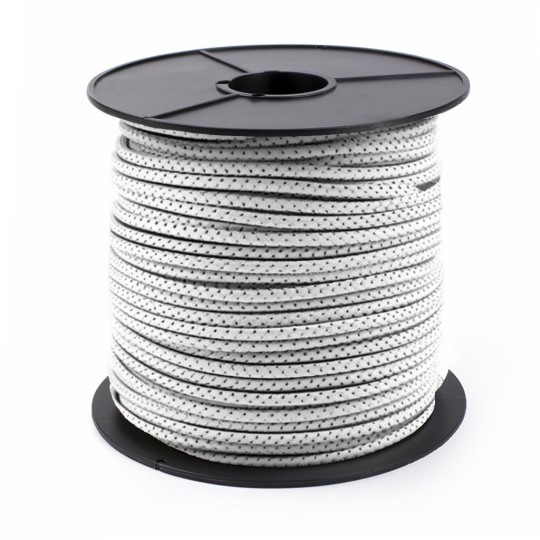
Fibrous/textile appearance
Most versatile
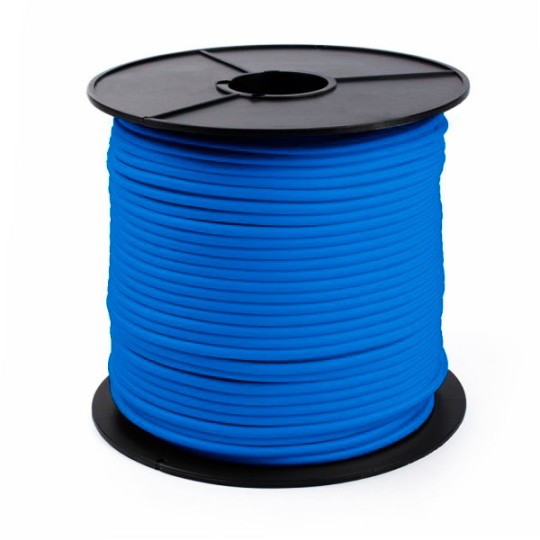
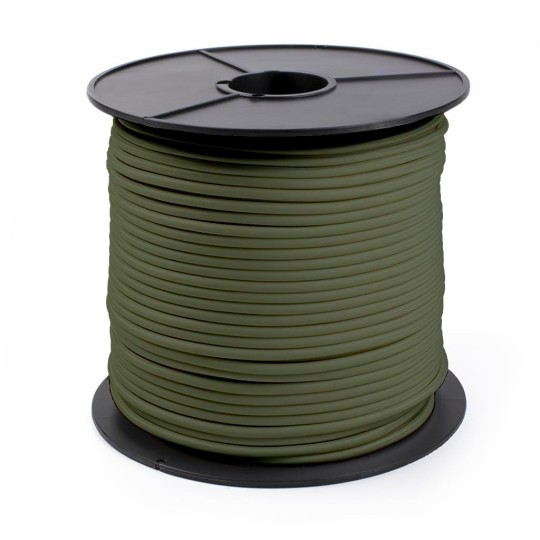
Elastic cords, widely known as sandow cords, pair an extruded natural rubber core with a braided outer sheath that protects it from wear, friction and UV. It's this two-part construction that gives the cord its stretch and lets it spring back into shape thousands of times over, within a working range of 25 to 75% elongation. Get the sizing right and it tensions and secures loads with no fuss; get it wrong and it either slackens off or snaps too soon. This guide will help you choose the right diameter, sheath, length and end fitting.
Diameter determines pulling power: the thicker the cord, the stronger the tension.
| Diameter | Tension | Typical Uses |
|---|---|---|
| Ø4 to 6 mm | Light | Fine cord, small fixings, lightweight structures |
| Ø8 mm | Medium | Everyday tie-down, tarpaulins, camping |
| Ø10 to 12 mm | Heavy-duty | High tension loads, heavy cargo, trailers |
Whatever the diameter, avoid stretching the cord beyond 75% elongation for long periods, to keep its elasticity intact over time.
The outer sheath makes all the difference to durability and service life. Three types cover every application:
| Sheath | Finish | Key Strengths | Best Suited To |
|---|---|---|---|
| Polypropylene 915D | Fibrous | UV-resistant, lightweight, cost-effective, quick-drying | Everyday outdoor use, all-round |
| Polyethylene 650 denier | Smooth | Abrasion-tested to ISO 12947-2 (+4000 cycles) | Friction points, heavy-duty use |
| Marine PES (1000) | Industrial-grade | Maximum UV and abrasion resistance, salt-resistant | Marine use, extreme conditions |
In short: polypropylene for all-round versatility, polyethylene for abrasion resistance (see Sandow cords), and marine PES for saltwater use.
An elastic cord should always be fitted under tension, never stretched taut to its limit. Since it performs best between 25 and 75% elongation, choose a resting length shorter than the span you need to cover: aim for roughly 60 to 70% of that distance. For example, to secure a load across around 1 m, a cord measuring 60 to 70 cm at rest gives good tension without over-stretching the rubber core. On cut-to-length models, keep to this margin rather than pulling the cord to its maximum, which wears out the core prematurely.
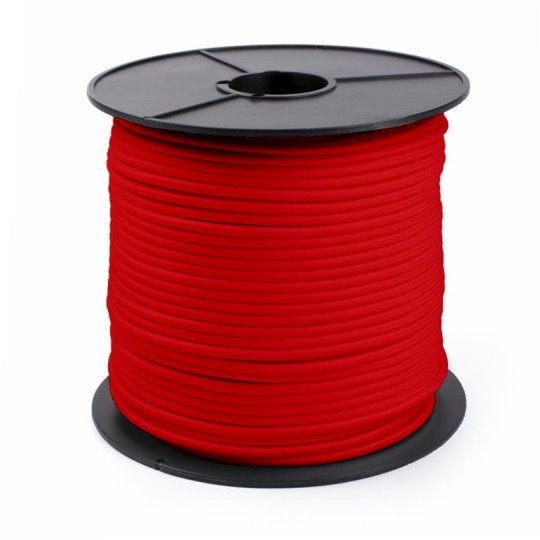
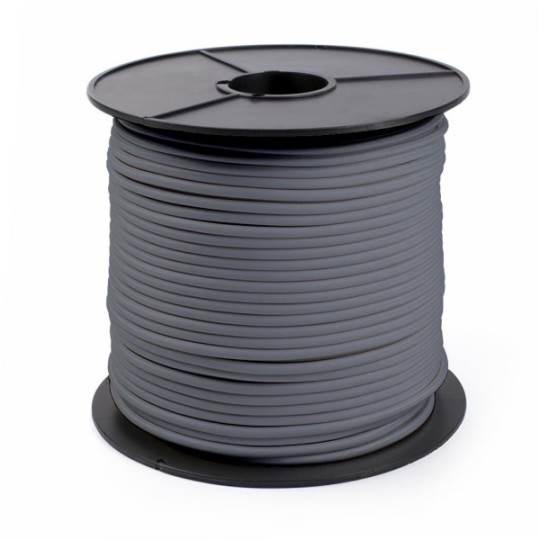
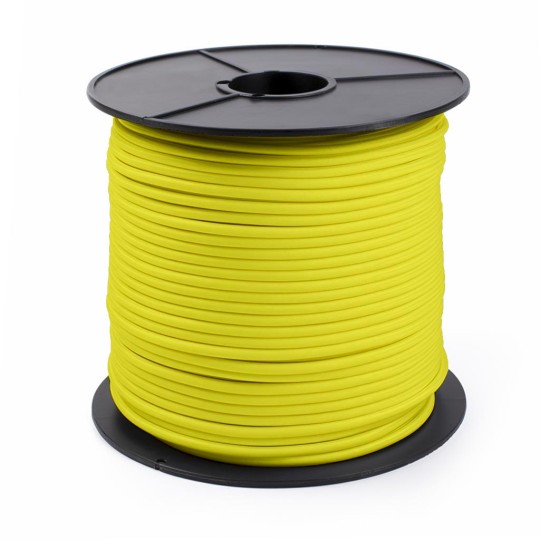
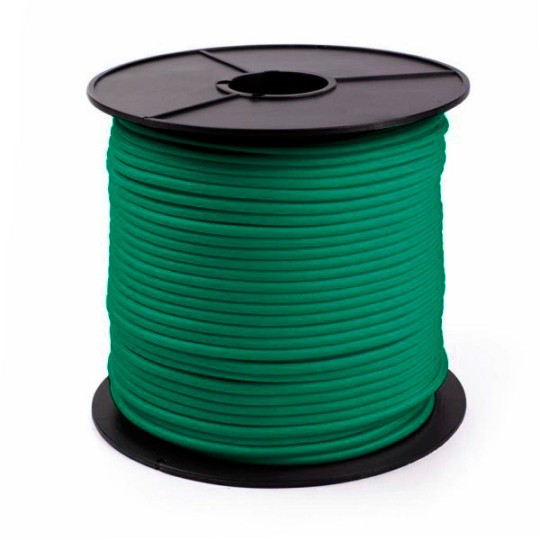
50 m and 100 m reels are designed for trade professionals and regular needs. If you only want the length you'll actually use, several models are also sold by the linear metre. For fine fixings, the Ø4 mm fine cord completes the range. Colours (black, white, grey, blue, red, green, yellow, NATO green) vary by model, making it easy to colour-code your kit.
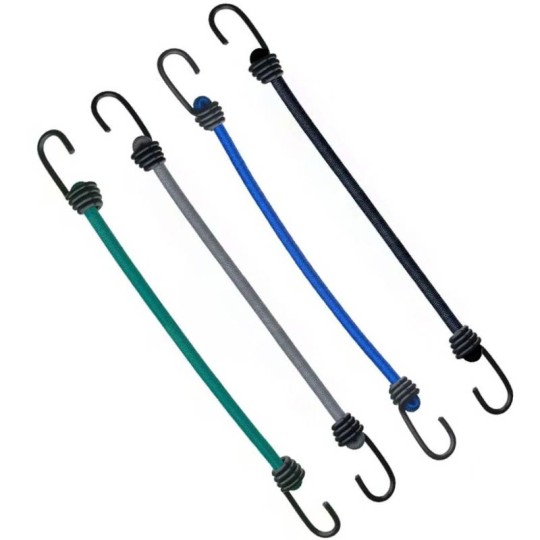
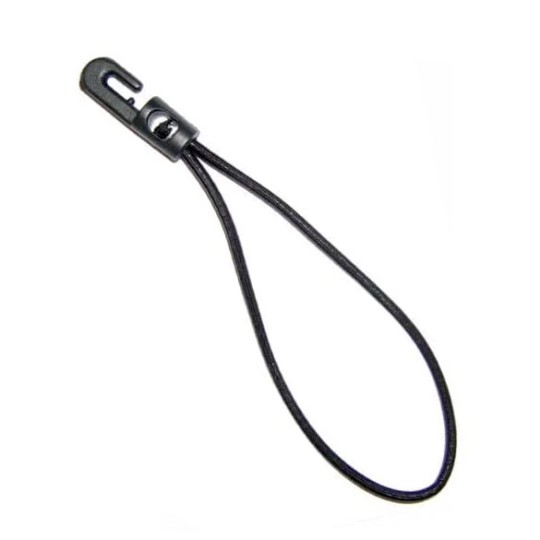
The simplest option is our ready-to-use bungee cords, already fitted with hooks. Otherwise, fit the cord with hooks or loops in the right diameter, either crimped on or screwed in place depending on the sheath (full method on our Sandow cords page). A simple knot will do the job for one-off use.
An elastic cord lasts well if you look after it: rinse it in clean water after exposure to salt or dust, store it out of direct sunlight and avoid leaving it permanently over-tensioned. Prolonged UV exposure and over-stretching are its two worst enemies. Replace any cord whose sheath is fraying (with visible loose fibres) or whose core no longer springs back into shape: it has lost its stretch.
Depending on your exact needs: polypropylene cord (all-round outdoor use), high-elasticity (maximum stretch), flat cord (mark-free), multi-strand (extra flexibility), marine (extreme conditions).
What's the difference between an elastic cord and a sandow cord? None: “sandow” is simply the everyday name for a rubber-cored elastic cord.
What diameter do I need to secure a tarpaulin? An Ø8 mm cord is enough for most jobs; go for Ø10 to 12 mm under heavier tension.
What length should I buy? Around 60 to 70% of the distance to be covered, since the cord stretches once it's fitted.
Can I buy it by the metre? Yes, alongside 50 m and 100 m reels, several models are also sold by the linear metre.
PP, PE or PES: which should I choose? PP for all-round use, PE for abrasion resistance, PES for marine environments.
How do I fix the ends? With hooks, bungee fittings or loops matched to the diameter, or simply with a knot.
Does the cord lose its elasticity over time? Yes, gradually, especially if left over-tensioned or exposed to continuous UV; keeping within 25 to 75% elongation and storing it out of the sun will extend its service life.
How far can it be stretched? The recommended range is 25 to 75% elongation.
Is it UV-resistant? Yes, both cores and sheaths are UV-treated; for permanent marine exposure, choose PES.